
Gene Set Enrichment Analysis in R
Dates
11-15 May 2026
To foster international participation, this course will be held online
Course overview
This course provides a comprehensive and practice-oriented introduction to gene set enrichment analysis methods used in transcriptomics, proteomics, and multi-omics workflows. Participants will learn common tools, conceptual background, statistical underpinnings, and real-world workflows. Students will learn to run, interpret, and report gene and feature enrichment analyses.
While the structure course shows all the topics we will tackle, the course is flexible and can be adapted depending on the students interest. There is also the possibility of working with your own data set.
TARGET AUDIENCE AND ASSUMED BACKGROUND
-
Basic knowledge of R
-
Familiarity with transcriptomic data analysis
LEARNING OUTCOMES
By the end of this course, participants will be able to:
-
Understand the principles and biological rationale of gene set enrichment analysis
-
Select appropriate gene set databases and annotation resources
-
Apply over-representation analysis (ORA) and interpret its results
-
Use ranking-based methods such as GSEA and CERNO effectively
-
Choose suitable ranking metrics and permutation strategies
-
Manage gene identifiers and resolve annotation challenges
-
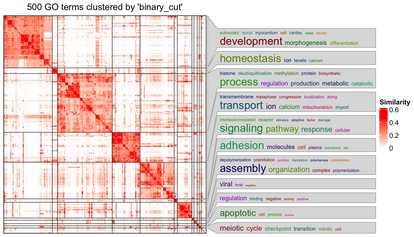
Reduce redundancy and interpret overlapping enrichment results
-
Visualize and communicate enrichment results responsibly
-
Apply advanced enrichment approaches, including topology-based and multivariate methods
-
Design, validate, and apply custom gene sets, including in single-cell and spatial analyses
Program
Sessions from 14:00 to 19:00 Berlin time.
Each day consist of four 30 minute lecture blocks followed by approximately 1 hour of hands-on exercises. After every topic will be discussion, Q&A, and practice. Students are encouraged to bring their data to the practice.
Day 1 — Foundations of Gene Set Enrichment
Introduction to gene set enrichment concepts, key databases (GO, KEGG, Reactome, MSigDB), statistical foundations including the hypergeometric test and multiple testing corrections. Hands-on
sessions cover environment setup, fetching gene sets, and running over-representation analyses with R and Python tools.
Day 2 — Advanced Methods: GSEA and Ranking
Deep dive into second-generation enrichment methods such as GSEA and tmod. Learn ranking strategies, permutation tests, and normalized enrichment scores. Practical exercises focus on constructing
ranked gene lists and running state-of-the-art enrichment algorithms.
Day 3 — Gene Ontology, Pathways & Annotation Challenges
Explore GO structure, pathway databases, and annotation complexities. Learn techniques to reduce redundancy and interpret overlapping results. Hands-on work includes GO enrichment, redundancy
reduction, and visualization techniques like UpSet plots.
Day 4 — Visualization, Validation & Multivariate Enrichment
Master advanced visualization methods (dot plots, enrichment maps, network graphs) and validation strategies for enrichment results. Introduces multivariate and topology-based approaches such as
GSVA, SPIA, and network enrichment with STRINGdb.
Day 5 — Custom Gene Sets, Single-Cell & Machine Learning Applications
Learn to build, curate, and validate custom gene sets using co-expression and network methods. Explore gene set enrichment in single-cell and spatial omics data, and the integration of machine
learning. Optional project work with your own dataset.

Cost overview
related courses
1 - Dealing with messy data in R - ONLINE, 8-10 April
2 - RNAseq for beginners - ONLINE, 19th-28th of May
Should you have any further questions, please send an email to [email protected]
Cancellation Policy:
> 30 days before the start date = 30% cancellation fee
< 30 days before the start date= No Refund.
Physalia-courses cannot be held responsible for any travel fees, accommodation or other expenses incurred to you as a result of the cancellation.